In the era of widespread use of electrical and electronic devices, the ability to properly charge discharged batteries is becoming increasingly important.

In the age of common presence of electrical and electronic devices, ever expanding mobility and remote-controllability a skill of charging all the different types of batteries may prove increasingly useful. From subsystems of our cars, to mobile devices – all of them need specific care and knowledge to keep them running. In today’s article we will offer You a guide to the battery charging basics and essentials, that will also answer the questions like: how to charge the device, how long do You need to charge it, how to properly attach a car battery to a charger/rectifier, and many, many more!
Each type of device has its specific requirements. For example, lead-acid models require different voltages and charging cycle profiles than their lithium-ion counterparts. It is important to always check the technical specifications and use chargers recommended by the manufacturer. Improper charging, such as using too high a voltage, can shorten the device's lifespan or even cause damage. It should be remembered that some models require periodic maintenance charging to maintain their maximum capacity, whilst some shall be stored in a discharged state to minimise the risk of fire.
It is important not to charge the device longer than necessary, as this can lead to damage. Lead-acid batteries should generally be charged with a current of about 10% of their capacity. For example, a model with a capacity of 50Ah should be charged using a current of 5A, which in theory, if maintained constantly, would allow charging the battery in about 10 hours. However, due to the subperfect efficiency of the process, as well as saturation phase at the end of charging, when higher voltage and lower current are used, charging such a battery from zero takes longer. In the case of lithium-ion variants, the process usually ends automatically when full charge is reached, minimizing the risk of damage. However, due to different physical phenomena it is most beneficial to use the lithium-ion batteries in the range of 20- 80 percent of its full capacity. This way we minimize the impact of the charging and discharging cycles on battery’s life. The device's condition should be regularly monitored to prevent deep discharge, which can also be harmful.
Always make sure the charger is turned off before connecting it to a discharged battery to avoid sparking. After connecting the clamps, check that the connections are secure and there is no risk of accidental disconnection. Also, ensure that both the battery and the charger are in a safe, well-ventilated area to avoid the accumulation of gases released during the process. Then set the charging parameters on the charger as close to correct ones as possible. After finishing, always disconnect the negative clamp first, then the positive one to minimize the risk of short circuit and protect Your equipment from surge wave.
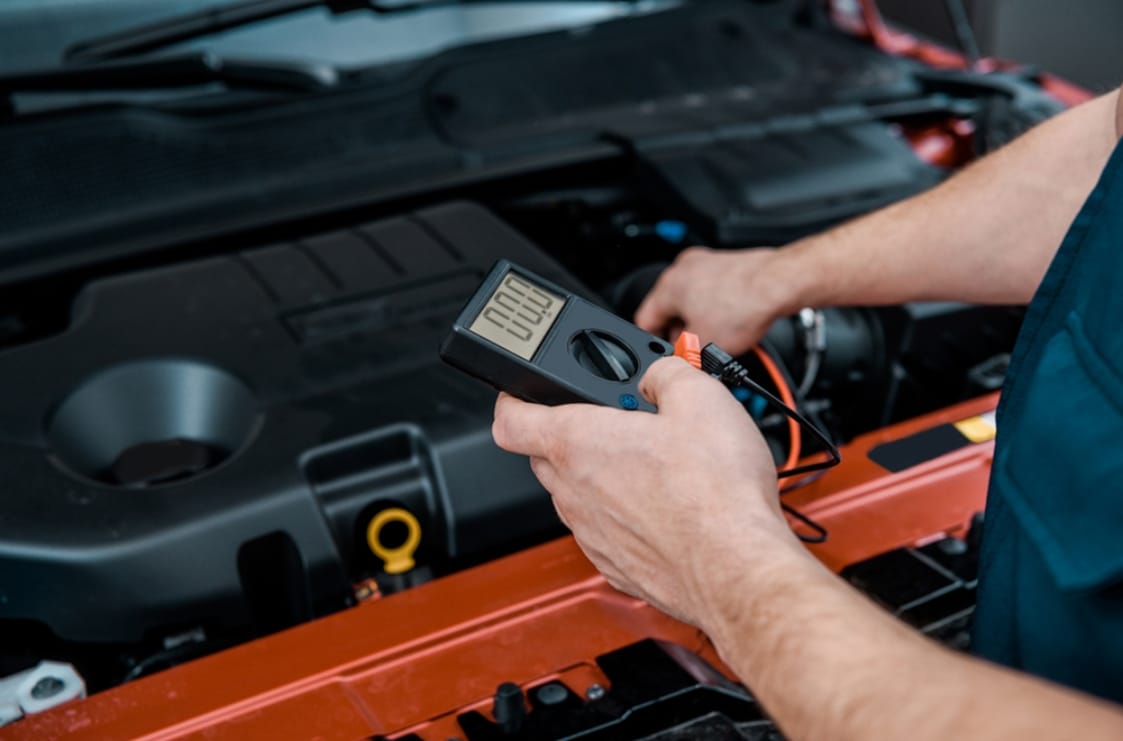
Checking the device voltage with a multimeter is a simple and effective way to assess its charge state for most battery types (except, for example, nickel-cadmium and nickel-metal hydride batteries). A battery is considered fully charged when it reaches its nominal voltage. However, it is worth remembering that voltage alone does not always give a full picture of the device's condition. For example, a battery may have high voltage but low capacity. Therefore, regular capacity tests are also important. Additionally, ambient temperature can affect voltage, which should be taken into account during measurements. A typical car battery should have a voltage above 12 V and is considered fully charged if the voltage exceeds 12.6 V. The maximum sustained theoretical car battery voltage after charging is 13.2 V.
Charging a device that has been completely discharged requires special care. A charger with a pulse charging function should be used. Such a charger gradually increases the current, allowing safe restoration of the device to full charge. Attention should also be paid to temperature — excessive heat is usually caused by increased internal resistance and may indicate internal damage. In the case of lithium-ion models, those batteries should be stored partially discharged, but not completely, as deep discharge can cause irreversible damage, so regular checks are recommended even if they are not heavily used. A lead-acid battery charged from a low state of charge sometimes takes over 24 hours because at the end of charging, desulfurization and saturation of the battery are performed using high voltage and low current.
Besides a voltmeter, there are specialized testers that can provide more detailed information about the battery's charge state and health. These testers often measure parameters such as internal resistance, which can help detect problems not visible through voltage measurement alone. Moreover, modern chargers often have built-in charge status indicators that automatically inform when the process is complete. It is important to regularly check the power source, especially in vehicles that are not used for a long time. Sometimes a battery has a so-called "magic eye" on one of the cells, which is a simplified electrolyte density meter; if the electrolyte reaches a sufficiently high density, the green top of the float becomes visible, indicating the battery is charged.
Regular monitoring of the power source helps to maintain its condition. For devices used in vehicles, if they are not used for a long time, periodic charging is recommended to prevent damage. For models used in portable devices, it is best to charge them when the charge indicator drops below 20-30%. This is especially important for lithium-ion batteries, which are sensitive to deep discharge.
The charging frequency depends on the model, usage, and operating conditions. For components used in cars, if the vehicle is used regularly, the battery is charged by the vehicle's alternator. For stationary models, such as those used in backup systems, it is important to maintain a regular schedule according to the manufacturer's recommendations. For batteries in portable devices, charging should be done according to user needs, paying attention to battery health. If the battery is not used, the voltage on its terminals or the state of charge should be checked once a month and charged if necessary. However, when it comes to car batteries, due to moderate voltage received from alternator, it is beneficial to charge a car battery on a charger at least once a year, before the winter. Such a charge shall finish with a high-voltage saturation stage, so that we reabsorb all the residue off the battery plates, and clear the electrolyte which reduces amount of nucleation kernels and lowers the electrolyte freezing point along with its high density.
There are various signs indicating that the power source is discharged. In cars, these may be problems starting the engine or weak operation of electrical components. In electronic devices, a discharged battery often manifests as rapid performance drop or complete device shutdown. Regular checking and charging help prevent complete discharge and extend battery life. Lead-acid batteries, such as those commonly used in passenger cars and road vehicles, are damaged if their voltage drops below 10.5 V, while they are considered discharged if the voltage on their terminals is below 12 V.
Proper charging and maintenance of devices are actions that not only ensure their long-term performance but also contribute to the safety of using devices powered by these batteries. Regular inspections, using appropriate chargers, and following manufacturer recommendations are key elements that help keep batteries in excellent condition for many years. If you have further questions regarding the use, charging, and replacement of batteries, feel free to contact our specialists who will always help and provide good advice on the subject.